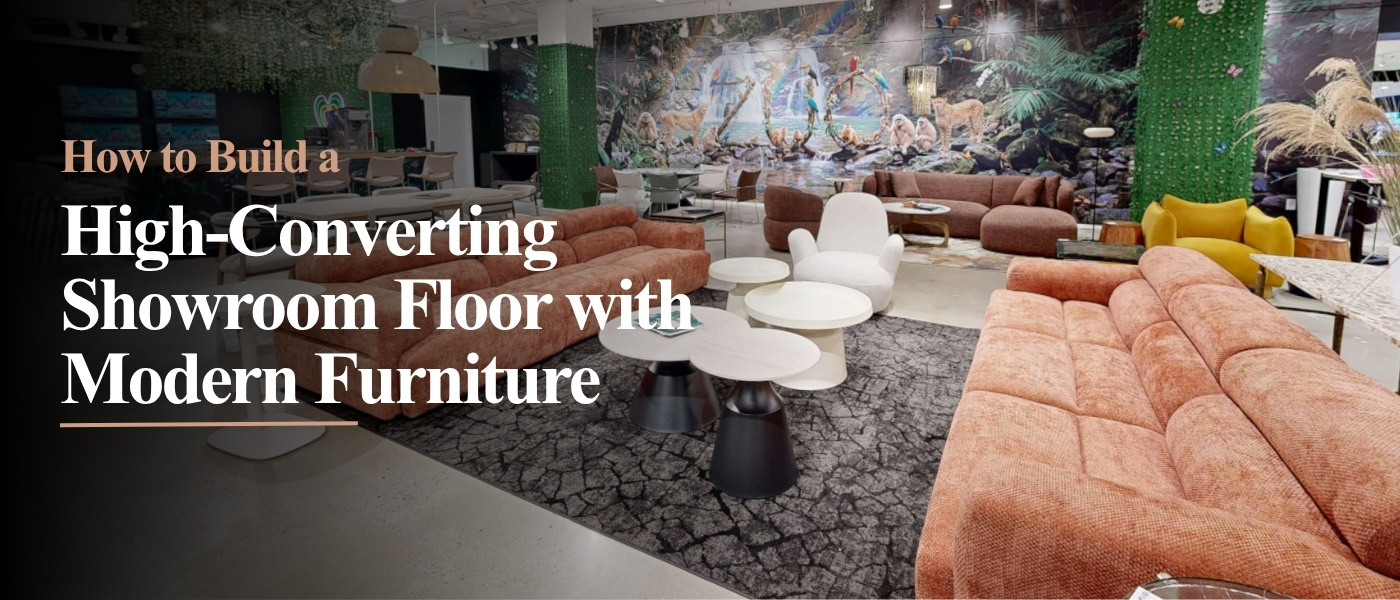
A modern showroom can look flawless and still underperform. The furniture may be stylish, the lighting polished, and the vignettes well designed, but if customers cannot quickly understand the style direction, pricing, product fit, and next step, the floor becomes more inspirational than transactional.
For furniture retailers, designers, specifiers, stagers, and hospitality buyers, a strong showroom floor should help people make decisions faster. The best layouts create clarity around what works together, what fits the buyer’s budget, what is available, and how to move forward.
Start With Flow
Before placing the next sofa, dining table, accent chair, or outdoor set, look at the floor as a path. Customers should feel naturally guided through the showroom instead of wandering without direction.
A strong layout creates a loop, protects sightlines, and gives people reasons to keep walking. The entrance should make an immediate impression without blocking what comes next. From there, use furniture groupings to create clear pause points.
A styled living room, dining vignette, lounge setup, or outdoor moment gives customers a reason to slow down, engage, and imagine the product in a real space. The goal is not just traffic flow. It is decision flow.
Create Three to Five Anchor Moments
A high-converting showroom needs clear “headline” moments. These are the vignettes that define your point of view and help customers understand the floor quickly.
An anchor moment might be a complete modern living room, a hospitality-inspired lounge, a dining story with multiple chair options, or a bedroom setting that feels finished without being over-styled. Each one should answer a few questions fast: What style is this? What type of space is it for? What else can I buy with it?
A showroom should not only show individual SKUs. It should show complete solutions.
Build a Clear Price Ladder
One of the biggest conversion blockers is price uncertainty. If the entire floor feels elevated but customers cannot identify accessible options, they may assume everything is out of reach.
Merchandise good, better, and best in a way that feels natural. Pair a strong value dining chair with a more elevated table, or place a higher-design accent chair near supporting pieces at more approachable price points. This helps buyers orient quickly and stay engaged.
This is especially important for B2B customers working across different budgets, from single-room projects to larger retail, staging, or hospitality needs.
Let Adjacency Sell More
Adjacency is one of the easiest ways to increase attachment. If someone is looking at a dining table, show chair options nearby. If they are considering a sofa, show the coffee table, side table, lighting, and accent seating that complete the room.
Modern furniture often sells better when customers can see how the materials relate: black metal legs with a table base, warm wood with cream upholstery, brass accents with lighting, or stone-look tops with textured fabrics.
These connections help buyers feel more confident because the showroom is doing part of the design work for them.
Show Real Use Cases
A chair on its own may look good. A chair in the right setting tells a stronger story.
Organize parts of the floor around applications, not only categories. Show compact dining, hospitality lounge, outdoor entertaining, modern bedroom, office seating, or apartment-ready living. This helps customers see how the product works for their specific needs.
For retailers, this creates ready-to-sell lifestyle stories. For designers, specifiers, stagers, and hospitality buyers, it helps communicate how pieces can function as packages or project solutions.
Balance Statement Pieces With Easy Sellers
Statement pieces bring energy to the floor, but they need support. A sculptural accent chair can create the moment, while tables, lighting, and simpler seating nearby help convert attention into an order.
The strongest showroom floors use bold design to attract interest and practical adjacencies to make the sale easier. Not every item needs to be the hero. Some pieces should anchor the look, while others make the room feel complete, useful, and easy to buy.
Make the Next Step Easy
A showroom should always make the next step obvious. That could be scanning a QR code, checking inventory, requesting a quote, asking for a tear sheet, building a package, or placing an order.
For B2B customers, speed matters. Designers, retailers, specifiers, and hospitality teams often need dimensions, finishes, materials, availability, freight details, and compatible items quickly. If the process is difficult, conversion slows down.
Inspiration gets people interested. Easy information helps them act.
Track the Floor Like a Sales Channel
A showroom is not just a display. It is a sales channel.
Track which zones get attention, which vignettes customers photograph, which products are discussed, and which groupings lead to larger orders. Watch attachment rate: are customers buying the chairs with the table, the tables with the sofa, or the nightstands with the bed?
If a zone looks great but does not perform, adjust it. Small changes in placement, signage, pricing, or adjacency can make a measurable difference.
A high-converting showroom floor is not about filling space with modern furniture. It is about helping customers move from inspiration to confidence.
The best showroom floors feel styled, but also shoppable. They show a point of view, create clear product relationships, and make it easy for buyers to understand what works together and what to do next.
Need help building modern furniture stories for your showroom or project? Connect with Zuo and our team can help you explore product combinations, category pairings, and display ideas that fit your customers, your floor, and your business goals
Email us at hello@zuomod.com with any questions.
Or give us a call at 510-877-4087 (Mon–Fri: 5:00 AM–5:00 PM PT)