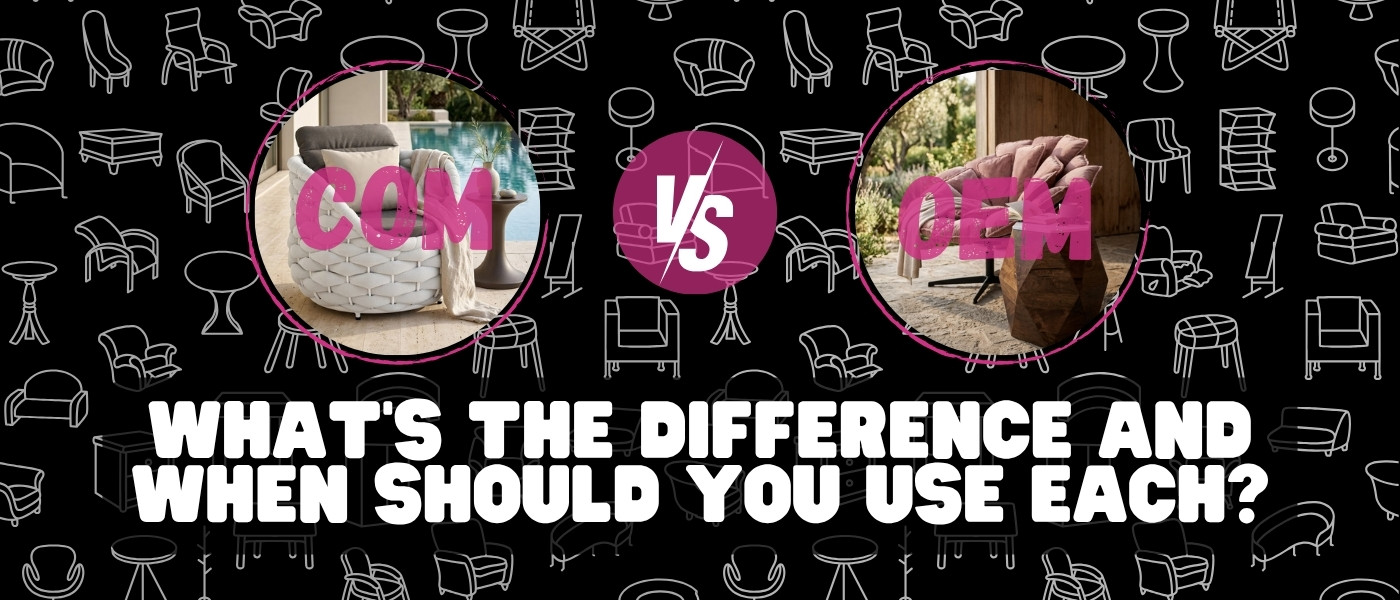
Customization is one of the biggest opportunities in contract and design work, but it is also where projects get delayed when teams talk past each other. Two terms come up constantly: COM and OEM. They are not interchangeable, and choosing the wrong one can cost you weeks.
Here is a practical way to understand both, decide which path fits your project, and ask the right questions early so customization feels controlled, not chaotic.
COM in Plain English: You Pick the Covering
COM means Customer’s Own Material. You are selecting the fabric (or sometimes leather or vinyl) and applying it to an existing product. The frame and silhouette stay the same; the covering changes.
COM is ideal when you need a specific performance textile, a brand-matched color, or a fabric story that ties multiple spaces together.
OEM in Plain English: You Are Building Something Different
OEM is a manufacturing pathway where the product itself can change: dimensions, details, construction methods, and sometimes the complete design.
It is the right path when your project requirements cannot be met by an existing frame, or when you need a proprietary design language.
When COM Is the Smart Move
Use COM when the look and performance live in the fabric, not the frame
COM is a strong fit when you need contract performance properties, want to match a brand palette, are refreshing a space without changing silhouettes, or need speed because the product frame is already proven.
When OEM Is Worth It
Use OEM when the product must be made for the project, not selected for the project: scale changes, construction reinforcements, proprietary design needs, or a different material system.
OEM generally includes engineering review, sampling, approvals, and minimum order quantities, but gives deeper control.
The Real Decision: Risk, Time, and Control
Ask three questions: where is the must-have value (fabric performance and palette vs shape and scale)? How much time do you have for approvals? What is your tolerance for change orders?
The clearer those answers, the easier the path choice becomes.
Questions to Ask Any Vendor Before You Commit
What is the realistic lead time including approvals? What are the minimums? Who owns freight risk and damage resolution? How are replacements handled later? What testing or compliance documentation is available or required?
How Zuo Thinks About COM
Zuo highlights COM as a flexibility tool for designers and hospitality buyers who need a specific look or performance story without building a product from scratch. The practical win is choosing proven frames and tailoring the finish through material choice.
If you’re weighing COM vs OEM for a project, start by listing what cannot change (performance, palette, scale, brand signature). Once that’s clear, the right path usually reveals itself quickly.
Email us at hello@zuomod.com with any questions.
Or give us a call at 510-877-4087 (Mon–Fri: 5:00 AM–5:00 PM PT)